
Precision Gear Manufacturing: 100% In-House Production Control
Explore our precision gear manufacturing process. Powered by imported Gleason grinders, we ensure strict quality control for custom OEM gears.
Precision is not an accident; it is a highly controlled process. By maintaining a 100% in-house manufacturing chain—from raw material forging to final Gleason CNC grinding—we eliminate supply chain variables, ensuring every differential assembly meets strict OEM specifications.
| Technical Parameter | Industry Standard | Our In-House Capability | Equipment / Method |
| Gear Quality Grade | DIN 7 / ISO 7 | DIN 5 / ISO 5 | Gleason & Klingelnberg CNC Grinders |
| Tooth Surface Roughness | Ra 0.8 um | Ra 0.4 um (Mirror Finish) | CNC Profile Grinding + Profilometer |
| Effective Case Depth | ±0.2mm Variance | ±0.05mm Precision | Continuous Carburizing Furnace |
| Surface Hardness | HRC 55-60 | HRC 58-62 (Core: 33-45) | Rockwell Hardness Tester |
| Critical Dimensional Tolerance | ±0.01mm | ± 0.003mm | SPC Monitoring & ZEISS CMM |
4-Step End-to-End Process
Step 1: Premium Raw Material & Forging
We exclusively source high-grade 20CrMnTi alloy steel. Our precision closed-die forging process optimizes the internal grain flow of the metal, maximizing the fatigue strength and impact resistance of the gear blanks.
Step 2: CNC Pre-Machining
Utilizing multi-axis CNC lathes and machining centers, we establish the critical datum surfaces. Strict tool life management guarantees dimensional stability before heat treatment, preparing the perfect geometry for gear cutting.
Step 3: Advanced Heat Treatment
The core of gear durability. Our continuous carburizing and quenching lines create a tough, ductile core (HRC 33-45) surrounded by an ultra-hard, wear-resistant outer shell (HRC 58-62), effectively preventing premature tooth breakage.
Step 4: Precision Gear Grinding
The final touch of perfection. Powered by imported Gleason gear grinders, we correct any minor heat treatment distortions. This process guarantees perfect tooth profile micro-geometry, drastically reducing NVH (Noise, Vibration, Harshness) during high-speed driveline operation.
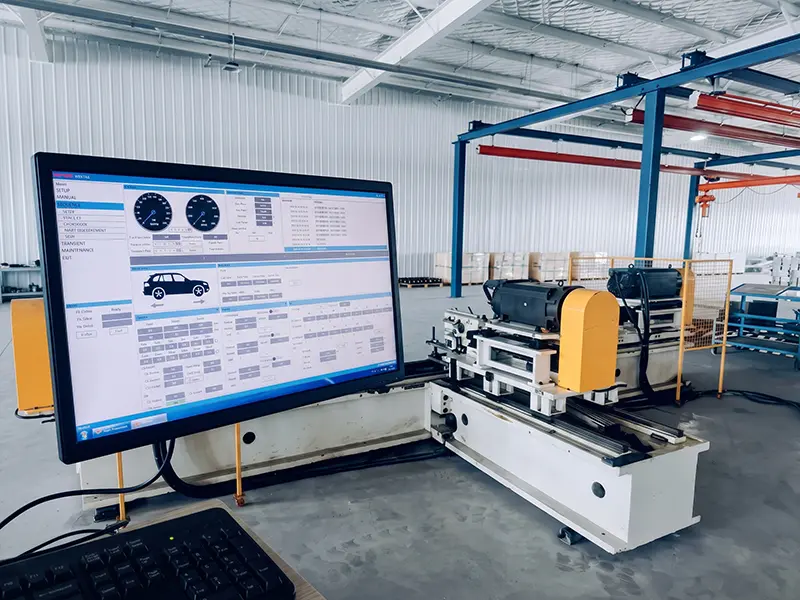
Advanced Machining & Gear Grinding Infrastructure
Step inside our production floor. Equipped with multi-axis CNC turning centers and imported Gleason gear grinders, our heavy-duty manufacturing fleet is engineered to maintain micron-level precision and strict batch consistency across high-volume OEM orders.



Frequently Asked Questions: Precision Gear Manufacturing Process
Q1: How do you maintain strict micron-level tolerances throughout your Precision Gear Manufacturing Process?
A: Our Precision Gear Manufacturing Process relies on 100% in-house, closed-loop control. During the roughing stage, high-rigidity CNC turning centers lock in the datum surfaces. The final finishing is executed by imported Gleason and Klingelnberg gear grinders, ensuring critical dimensional tolerances are strictly held within ±0.003mm for a seamless drop-in assembly.
Q2: Heat treatment often causes gear distortion. How does your manufacturing process address this industry pain point?
A: Managing distortion is a core technical advantage of our Precision Gear Manufacturing Process. We utilize continuous carburizing and quenching furnaces to precisely control the effective case depth (Case: HRC 58-62, Core: HRC 33-45). Crucially, all ring and pinion gears undergo mandatory precision gear grinding after heat treatment, completely eliminating any minor thermal distortion and perfectly restoring the micro-geometry of the 3D tooth profile.
Q3: For high-volume automotive OEM orders, how do you guarantee quality consistency across different batches?
A: Ultimate stability comes from removing the over-reliance on manual intervention. Our Precision Gear Manufacturing Process deeply integrates SPC (Statistical Process Control) with APQP/PPAP frameworks. From the closed-die forging of 20CrMnTi alloy steel to fully automated CNC machining, consistent machine parameters guarantee that hundreds of thousands of parts share the exact same mechanical properties and dimensional accuracy.
Q4: Can your Precision Gear Manufacturing Process help optimize the NVH (Noise, Vibration, Harshness) performance of the differential?
A: Absolutely. Reducing whine and vibration during high-speed operation is a hard requirement for premium drivetrain components. Within our Precision Gear Manufacturing Process, gear grinding optimizes the tooth surface finish down to Ra 0.4 $\mu m$ (mirror-like). Combined with dynamic backlash testing before rollout, this effectively reduces friction and stress concentration during gear meshing, delivering whisper-quiet performance.
Q5: What level of material and quality inspection traceability does this manufacturing process offer?
A: We provide ultimate supply chain transparency. As an IATF 16949 certified facility, our Precision Gear Manufacturing Process features an end-to-end traceability system. From incoming raw material verification via direct-reading spectrometers, to forging batches, heat treatment lot numbers, and final CMM inspection data, every shipment includes a comprehensive Material Test Report (MTR), minimizing compliance risks for procurement managers.
Ready to Upgrade Your Drivetrain Supply Chain?
Get engineered gear solutions tailored to your technical specifications. Fast response within 12 hours
- 12-Hour Response Guarantee
- Strict NDA Protection
- Free DFM & CAD Review