In modern drivetrain architectures, particularly within commercial heavy-duty vehicles and high-RPM Electric Vehicles (EVs), NVH (Noise, Vibration, and Harshness) is no longer a secondary comfort metric—it is a critical pass/fail engineering standard.
The transition to electrified powertrains has eliminated the masking effect of internal combustion engines (ICE). Without the low-frequency rumble of a diesel or gas engine, the high-frequency whining, gear rattle, and clunking of a differential and reducer housing become glaringly obvious to the end user. In the commercial sector, excessive NVH accelerates bearing fatigue and reduces the MTBF (Mean Time Between Failures) of the entire axle assembly. Once an NVH issue reaches the production stage, OEMs face astronomical costs in warranty claims, product recalls, and brand damage.
When troubleshooting drivetrain noise, chassis engineers often default to blaming the gear geometry. The assumption is usually: “The gears must be cut wrong.”
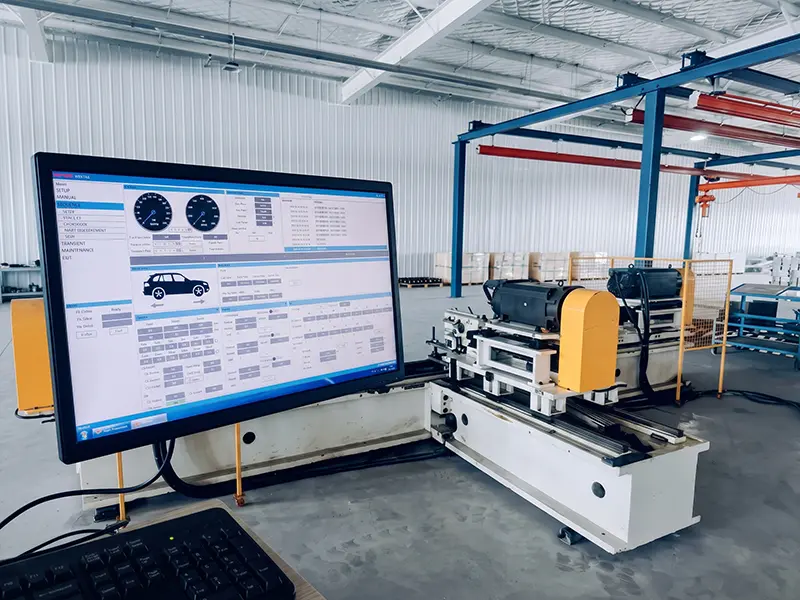
However, empirical data from thousands of end-of-line (EOL) acoustic tests at our Tier-1 manufacturing facility reveals a different reality. While gear micro-geometry is undeniably important, up to 60% of persistent, high-frequency NVH issues originate from the differential housing’s machining tolerances and the omission of post-heat treatment corrections.
When outsourcing custom differential manufacturing, avoiding these three critical design and machining mistakes will save your engineering team months of troubleshooting and safeguard your drivetrain’s acoustic performance.
Mistake 1: Ignoring Bearing Bore Concentricity and Tolerance Stack-Up
The Engineering Phenomenon
You have designed a differential with perfect gear parameters on CAD. The spiral bevel gears have an optimized contact ratio, and the theoretical transmission error (TE) is practically zero. Yet, when the prototype is assembled and put on the dynamometer (dyno), it produces a cyclical, high-pitched whine that spikes at specific RPMs.
The Root Cause: Multi-Setup Machining
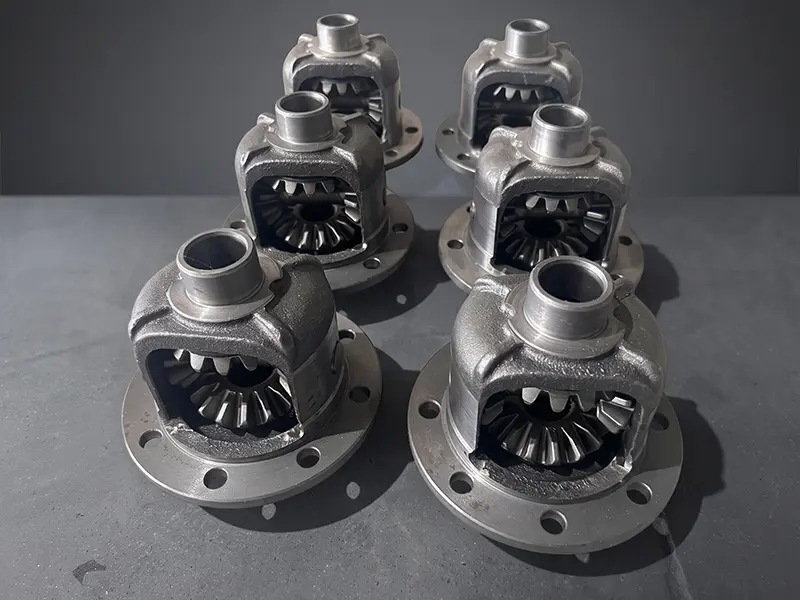
The root cause often lies not in the gears, but in the cast iron or aluminum differential housing—specifically, the concentricity of the carrier bearing bores.
Many lower-tier machine shops utilize traditional, multi-setup CNC milling and turning processes. They will machine one side of the differential housing, physically unclamp the workpiece, flip it, re-clamp it, and machine the opposite bearing bore. Every time a workpiece is re-fixtured, a microscopic setup error occurs.
In precision engineering, this is known as “tolerance stack-up.” Even if the machine itself is highly accurate, the physical act of re-clamping can introduce a concentricity deviation of 0.02mm to 0.05mm between the left and right bearing journals.
The NVH Implication
At low speeds, a 0.03mm offset might go unnoticed. However, at 10,000+ RPM—typical of modern EV e-axles—this microscopic misalignment is catastrophic. If the bearing bores are not perfectly concentric, the entire differential carrier sits at a slight angle relative to the pinion gear.
This angular deviation alters the meticulously designed gear contact patch. Instead of the load being distributed evenly across the center of the gear teeth, it shifts toward the heel or the toe, or climbs toward the tip of the tooth. This edge-loading not only causes premature wear but also acts as an acoustic amplifier, exciting the gear mesh frequency and generating an aggressive, high-pitched whine that resonates through the vehicle chassis.
The Tier-1 Manufacturing Solution
To eliminate NVH caused by concentricity failures, the design and manufacturing protocol must mandate Single-Setup CNC Machining.
At XiangYue, our advanced multi-axis CNC machining centers are programmed to bore both carrier bearing journals and face the ring gear mounting flange in a single, continuous operation without ever releasing the workpiece. This eliminates fixture-induced tolerance stack-up, guaranteeing absolute concentricity and zero flange runout. Furthermore, we mandate 100% CMM (Coordinate Measuring Machine) verification for all bearing bores before the housing is cleared for assembly, ensuring the physical product perfectly mirrors the CAD intent.
Mistake 2: Underestimating Housing Flex Under High Dynamic Torque
The Engineering Phenomenon
During the validation phase of custom differential manufacturing, a prototype might pass all NVH tests on an unloaded dyno bench. It sounds smooth and operates within acceptable decibel limits. However, once installed in a heavy-duty commercial truck under a full payload, or in a high-performance EV during maximum torque vectoring, a severe NVH issue emerges. Drivers report a harsh metallic “clunking” during hard acceleration or a sudden onset of gear howl under heavy loads.
The Root Cause: Insufficient Structural Rigidity
This mistake occurs when engineers design a differential housing based solely on static load calculations, ignoring the extreme dynamic forces at play.
A differential housing might look like a solid block of impenetrable metal on a screen, but under 10,000+ Nm of peak torque, it behaves like a very stiff spring. If the housing wall thickness is insufficient, or if the material grade lacks the necessary tensile strength, the entire carrier will experience “elastic deflection” (flexing).
The NVH Implication
When you assemble a differential, technicians spend hours using shims and dial indicators to set the perfect gear backlash (typically around 0.15mm to 0.20mm) and bearing preload.
If the housing flexes under a heavy load, that perfect 0.15mm backlash is destroyed in real-time.
- If the housing flexes away from the pinion, the backlash increases rapidly. The gears begin to separate, reducing the contact ratio and causing the teeth to “slap” against each other, creating a harsh clunking noise (backlash rattle).
- If the housing twists and forces the gears closer together, the backlash drops to zero. The gears bind, generating massive amounts of friction, localized heat, and a deafening howl that will quickly lead to catastrophic metallurgical failure.
The Tier-1 Manufacturing Solution
Resolving housing flex requires a synergy of advanced material science and FEA (Finite Element Analysis) optimized structural design.
- Material Selection: For commercial and off-highway heavy-duty applications, standard grey cast iron is unacceptable. We strictly utilize high-strength Ductile Iron (Nodular Iron), such as QT500-7 or QT600-3. The nodular graphite structure inherently dampens vibrations while providing immense tensile strength to resist deflection. For lightweight EV applications, we utilize aerospace-grade A356-T6 aluminum, heat-treated for maximum rigidity.
- Strategic Ribbing: During the DFM (Design for Manufacturing) phase, we analyze stress concentrations. Instead of blindly adding wall thickness (which adds unnecessary unsprung weight to the vehicle), we integrate strategic structural ribs (webbing) around the bearing caps and pinion support areas. This maximizes rigidity exactly where the dynamic forces attempt to separate the gears, keeping the backlash constant regardless of the torque load.
Mistake 3: Skipping Post-Heat Treatment Profile Grinding
The Engineering Phenomenon
To cut upfront NRE (Non-Recurring Engineering) costs and lower the per-unit price, a purchasing manager decides to streamline the gear manufacturing process. The factory cuts the gears using precision CNC hobbing and milling, achieving an excellent involute profile in the “soft” metal state. The gears are then sent to a continuous carburizing furnace for case hardening to ensure longevity. After quenching, they are assembled directly into the housing.
The gears are incredibly hard and durable, but the differential screams like a siren at highway speeds.
The Root Cause: Metallurgical Distortion
This is one of the most common and devastating mistakes in custom differential manufacturing and gear cutting. Heat treatment is a violent metallurgical process. When a machined steel gear is heated to over 900°C (1650°F) in a carbon-rich atmosphere and then rapidly quenched in oil or polymer, the molecular structure of the steel changes.
This phase transformation introduces massive internal stresses. As a result, the metal warps. The perfectly cut involute tooth profile that came off the CNC milling machine is no longer perfect. The teeth may swell, twist, or taper by just a few microns—invisible to the naked eye, but catastrophic to acoustics.
The NVH Implication
Gears operate by rolling and sliding against one another. To do this quietly, the “Transmission Error” (TE) must be minimized. When heat-warped gears mesh, they do not roll smoothly; they micro-collide.
Every time a warped gear tooth engages, it creates a microscopic impact. If the gear has 40 teeth and is spinning at 3,000 RPM, that is 120,000 micro-impacts every single minute. These impacts transmit directly through the bearings into the differential housing, transforming the metal casing into a giant acoustic speaker that broadcasts high-frequency NVH directly into the vehicle cabin.
The Tier-1 Manufacturing Solution
There is no shortcut around metallurgy. For any high-RPM or NVH-sensitive application, Hard-State CNC Profile Grinding is a mandatory final operation.
At XiangYue, our production logic strictly dictates that hobbing and milling (Operations 01) are only preparatory steps. After the gears undergo continuous carburizing and shot peening (to induce compressive residual stress for fatigue life), they return to the CNC machining center.
Using specialized diamond-dressed grinding wheels, we perform micro-level profile grinding on the hardened gear teeth. This process physically grinds away the heat-treatment distortion, restoring the involute profile to DIN 4 / AGMA 12 quality standards. Furthermore, profile grinding allows us to add “micro-geometry modifications”—such as tip relief and crowning—which ensures a smooth transfer of load from one tooth to the next, entirely eliminating the micro-impacts that cause NVH.
Conclusion: NVH is a Systemic Manufacturing Challenge
Eliminating NVH in custom differential manufacturing is never the result of a single lucky CAD drawing. It is a rigorous, systemic engineering discipline that requires total control over casting metallurgy, multi-axis CNC machining, and post-heat treatment finishing.
When you source drivetrain components, you are not just buying metal parts; you are buying the manufacturer’s internal quality control logic. Ignoring concentricity, under-engineering the housing rigidity, or skipping profile grinding will guarantee NVH failures that cost vastly more than the initial manufacturing savings.
Don’t let hidden manufacturing tolerances destroy your drivetrain’s acoustic performance.
At XiangYue OEM Differential & Gear Manufacturer, we bridge the gap between engineering theory and production reality. We provide Tier-1 automotive tolerances, 100% CMM verification, and meticulous backlash/preload calibration to deliver drop-in ready, zero-NVH differential assemblies for the world’s most demanding commercial and EV applications.
Ready to optimize your custom differential manufacturing project? 📧 Submit your drawings for a free DFM (Design for Manufacturing) review: [sean@drivegearsmfg.com]
🌐 Explore our precision manufacturing capabilities: [www.drivegearsmfg.com]